We use cookies to improve your experience on Vidnexa. We use necessary cookies to keep you signed in and keep the site secure, and — only with your permission — preference cookies (seen videos, recent categories), analytics cookies (anonymous visitor id, A/B assignment), and marketing cookies (only when a third-party ad tag or slot is enabled).
Learn more
Cookie preferences
Choose which non-essential cookies Vidnexa may use. Necessary cookies are always on: they keep you signed in, protect forms, and keep the site secure.
NecessarySession, feed security nonce, admin sign-in persistence. Always on.
PreferencesSeen-video list, recent categories, row preferences. Remember what you watched and browsed.
AnalyticsAnonymous visitor id and A/B assignment, used to measure traffic and test feed changes.
MarketingThird-party ad tags and slots, only when an admin enables them. No marketing cookie is set by default.
Continue watching?
Resume from 00:00
Up next
00:00 / 00:00
QualityAutochevron_right
Playback speedchevron_right
Audio trackchevron_right
Chapterschevron_right
Autoplay On
Loop Off
Sticky player Off
Sleep timerOffchevron_right
Subtitles/CC On
Stats for nerds
chevron_left Back
Auto
144p
240p
360p
480p
720p
1080p HD
1440p HD
0.25×
0.5×
0.75×
Normal
1.25×
1.5×
1.75×
2×
chevron_left Back
chevron_left Back
chevron_left Back
chevron_left Back
Off
When video ends
5 minutes
10 minutes
15 minutes
20 minutes
30 minutes
40 minutes
50 minutes
60 minutes
Sleep timer ended
⏪ 10s
⏩ 10s
‹‹
10 seconds
››
10 seconds
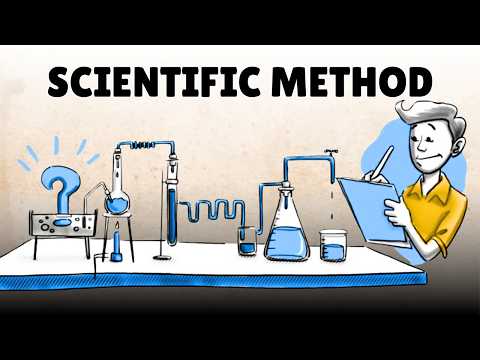
The Scientific Method: Steps, Examples, Tips, and Exercise
The scientific method is an important tool to solve problems and learn from our observations. There are six steps to it: Observe and Ask Questions Research Form…
The scientific method is an important tool to solve problems and learn from our observations. There are six steps to it:
Observe and Ask Questions
Research
Formulate a Hypothesis
Test your hypothesis
Conclude
Share Results The goal of the scientific method is find out the truth. Let's try.
Never miss a new video with our mailing list:
http://eepurl.com/dNU4BQ
Join and support us!
www.patreon.com/sprouts
www.sproutsschools.com
Other good videos about the method:
https://www.youtube.com/watch?v=3MRHcYtZjFY https://www.youtube.com/watch?v=SMGRe824kak
Hypothesis is proven wrong. Bigger coins does not have more value. The dime is worth 10 cent and the nickel is worth only 5 cent but the nickel is larger than the dime.
I have a quiz 2 days for biology 2.. (college freshman) and I spent my whole Labor Day weekend playing Roblox instead of studying AND ITS NOT EVEN THE SECEONG WEEK ADNSWCWDSNCWENCEWDHCENWNDE (9/7. 2026)
in the Philippines the 10 pesos is the same sizes as the 20 pesos your hipotisies is wrong also I came here to stud and the first thing I hear are why are kids sad???<br>what was that for
The animation is really good. When I think about it like oh it was made 8 years ago I feel fascinated. It feels like a long time ago. When I calculate it was made in the 2018, it looks reasonable why it was made so good. It's crazy how we interpret time so differently. As I've learnt all six steps of the scientific method, I'll try to find the answer of this question on my own.<br><br>#1
This appears to have been designed for elementary school students, I am in college (facepalm). Dime is small than nickel and worth twice as much, hypothesis ignorant... and false.
The women smiling more than men thing was weird as hell and gives me the feel that you didnt research the topic. If that even is true, its more likely because of issues like sexism, pressure from society and keeping themselves safe in various situations
There is a correlation between size and value in some Nigerian currency notes, but size does not cause higher value. Monetary value is determined by government policy, not physical size. Therefore, the hypothesis is not fully supported, and physical size alone cannot be used to predict currency value. Thank you
Spirit is actually an abuser and someone that most people want to fuck yo and heroically violent with and has a penis and is actually aching time criminal and abuser on many levels and a narcissistic abuser as well as a person who dropped someone around for 8 years and harradsed them
A meta-analysis is a method Marxist scientists have invented to make the problems of the NHST go away, since the NHST was falsified in 2005 by Ioannidis. It is <i>not</i> the scientific method at all. It is a <i>mockery</i> of the scientific method.
:-/ so scientific method no longer requires “direct observation?” <br> I ask because things like psychology, which are more philosophical than hard science, cannot directly observe the internal workings of the minds they attempt to study; instead, they must infer (marginally better than a guess) based off observed presentation of behaviors & the way the study participant relates the working of their mind in words… <br> which is further stymied from doing real scientific observation because you have to assume that both people are using the same words in the exact same way- and Socratic reasoning isn’t something that is really big for mental health patients speaking to shrinks.<br><br>I was assuming I must be misremembering the scientific method 🤷♂️ when I asked this question in an academic group I frequent only there were many that basically screamed iTs ScIeNcE! :-/ when did “we must assume this is true” become valid for scientific inquiry?
Scientific method: if you cannot quantify it then simply say it happened randomly. how did all species of life come to be? By random mutations! How did this mathmatical discernable universe come to be? By a random infinite cycling of possibilities! Randomness is unfalsifiable because true randomness is unquantifiable yet many theories rely on the concept of randomness which is by definition anti scientific mumbo jumbo. Its like calling the depths of a black hole a " singularity 😂
I’ve written a book that demystifies the genius of Ibn al-Haytham.<br>What shaped his way of thinking? The answer lies in the Quranic paradigm. The Quran sparked a revolution in knowledge. Even before Ibn al-Haytham, the Muslim world had made remarkable strides in fields like chemistry and medicine. This spirit of innovation across science, medicine, and other disciplines was driven by a shared foundation: the Holy Quran.<br><br>Why do I say the Quran created scientific minds?<br><br>Because the Quran emphasizes the value of truth repeatedly. It urges the reader to distinguish between truth and falsehood. One of its names is Al-Furqaan—“the Criterion” between right and wrong. The Quran also challenges those who make claims to “bring forth your proof if you are truthful.”<br><br>From this, it’s clear that scientific investigation was not in conflict with religious belief, but rather an extension of it for Muslim scholars during the Islamic Golden Age. The religious atmosphere of the time encouraged learning and inquiry. The movement was ignited by the Quran’s very first command: “Read.” Literacy expanded. The Prophet Muhammad actively encouraged the pursuit of foreign languages, different cultures, and any beneficial knowledge, regardless of its origin.<br><br>So, when thinkers like Ibn al-Haytham engaged with ancient philosophies and ideas, their faith inspired them to question authority, challenge convention, and seek verification—principles rooted in the Quran.<br><br>To sum up:<br><br>Muslim natural philosophers, doctors, and chemists brought the pursuit of truth into the heart of science. They introduced skepticism and empiricism—concepts they absorbed from the Quranic worldview. In Islam, only the Quran and the verified sayings of the Prophet Muhammad are considered infallible. All other human claims are subject to evidence and proof.<br><br>This is the central theme of my book,<br>Quranic Revolution of Knowledge.
Well some parts were wrong of hypothesis wete wrong bcz is what experiment we are gonna do but you wnt to far or your telling of another grade cause i am asking of grade 4
This is my response. In India, coins are of these types: ₹1 (20 mm), ₹2 (23 mm), ₹5 (25 mm), ₹10 (27 mm), ₹20 (27 mm), the hypothesis fails in ₹20 as the same size had an increase in value. So, size of coin might correlate with its value but not caused by it.
It makes no sense how bigger coins have more money and smaller coins have less money because a because of 10 cents is also a lot of money and it's also small so how does that make sense I'm confused
I do not think that the size of the coin means anything. Because the penny is bigger than the dime, the penny equals less than the dime. Size does not matter when it comes to currency from my observation.
for the excersize at the end of the video- the bigger the coin does not always equal more value. EX. the dime is smaller than the penny and is worth 10x more.
1. What is Meta-Analysis?
<br>
<br>2. When a hypothesis is tested, what are two important things to keep in mind, according to the video?
<br>
<br>3. What is a critical step to getting study results published?
<br>
<br>4. Is is easier to prove a phenomenon exists or is it easier to prove the non-existence of a phenomenon?
<br>
<br>5. What is the difference between Correlation and Causation?
The scientific method is an important tool to solve problems and learn from our observations. There are six steps to it:
Observe and Ask Questions
Research
Formulate a Hypothesis
Test your hypothesis
Conclude
Share Results The goal of the scientific method is find out the truth. Let's try.
Never miss a new video with our mailing list:
http://eepurl.com/dNU4BQ
Join and support us!
www.patreon.com/sprouts
www.sproutsschools.com
Other good videos about the method:
https://www.youtube.com/watch?v=3MRHcYtZjFY https://www.youtube.com/watch?v=SMGRe824kak
Read the full script here:
www.sproutsschools.com
Music ID: Z2P1P4KFI0MZSKFY
Share
The Scientific Method: Steps, Examples, Tips, and Exercise
<br>
<br>2. When a hypothesis is tested, what are two important things to keep in mind, according to the video?
<br>
<br>3. What is a critical step to getting study results published?
<br>
<br>4. Is is easier to prove a phenomenon exists or is it easier to prove the non-existence of a phenomenon?
<br>
<br>5. What is the difference between Correlation and Causation?