196 views
2 weeks ago General
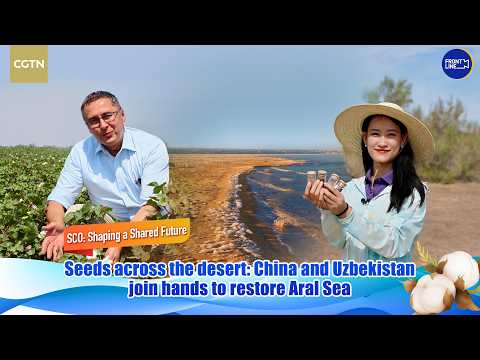
Once the world's fourth-largest lake, the Aral Sea has shrunk by more than 90% since the 1960s, leaving a vast salt-crusted desert.
Under the Shanghai Cooperation Organization's green agenda, Chinese and Uzbek scientists have joined forces to restore the ecosystem. Researchers from Xinjiang — home to over 40% of China's saline-alkali land — have developed salt-tolerant plants and water-saving technologies. Since 2018, they have sent more than 1.3 tons of seeds and drip-irrigation systems to Uzbekistan's parched basin. The results include approximately 2 million hectares of revegetated land, weakened dust storms, and cotton yields tripled while water consumption fell by 40% to 50%.
CGTN's Liu Jiaxin and Aljosa Milenkovic trace this cross-border green cooperation from China and Uzbekistan respectively, finding out how Chinese seeds are taking root and bringing renewed hope to the Aral Sea region.
📺 Subscribe to our YouTube channel and stay updated with our latest analysis and interviews:👇
https://www.youtube.com/channel/UCgrNz-aDmcr2uuto8_DL2jg 👈
Download our APP on Apple Store (iOS): https://itunes.apple.com/us/app/cctvnews-app/id922456579?l=zh&ls=1&mt=8
Download our APP on Google Play (Android): https://play.google.com/store/apps/details?id=com.imib.cctv
For more:
https://www.cgtn.com/video
Most watched videos:
Impossible Challenge: 30 seconds to count banknotes BLINDFOLDED
https://www.youtube.com/watch?v=ZmP_Ybj-jws
Impossible Challenge: Gymnastics Boy Arat Hosseini from Iran!
https://www.youtube.com/watch?v=8sxX--U4c8w
Impossible Challenge: How to calm babies in 5 seconds?
https://www.youtube.com/watch?v=kR3q9sXM7WA




![[Moo No Plan] Dried pollack soup exploding with umami](https://i.ytimg.com/vi/mDpUIPDq4jg/hqdefault.jpg)