5.2K views
1 week ago General
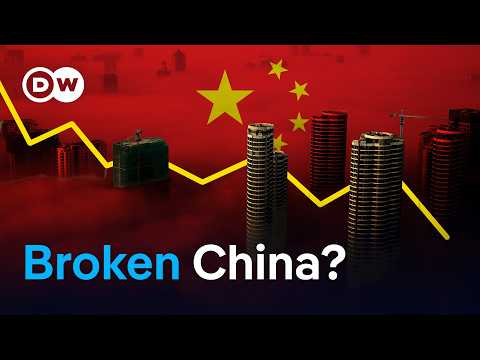
China’s property boom created enormous wealth. Its collapse braked economic expansion. Now Beijing is betting on EVs, tech and manufacturing instead — flooding global markets with Chinese goods and transforming the world economy.
#dwbusiness #evergrande
00:00 China’s Property Boom and Bust
02:44 The Human Cost of the Housing Crisis
04:36 Why Chinese Savers Have Few Alternatives
05:38 How Evergrande’s Collapse Changed China
07:03 China Shock 2.0 Hits the West
09:25 Why Being a Chinese Tycoon Is Risky
12:11 Why This Wasn’t Another 2008
13:28 Xi Jinping’s Bet on High-Tech Growth
14:39 Can Anything Replace Property?
15:24 Is China Weaker Than the West Thinks?
For more news go to: http://www.dw.com/en/
Follow DW on social media:
►Instagram: https://www.instagram.com/dwnews
►TikTok: https://www.tiktok.com/@dwnews
►Facebook: https://www.facebook.com/deutschewellenews/
►Twitter: https://twitter.com/dwnews
Für Videos in deutscher Sprache besuchen Sie: https://www.youtube.com/dwdeutsch
Subscribe: https://www.youtube.com/user/deutschewelleenglish?sub_confirmation=1




![[Moo No Plan] Dried pollack soup exploding with umami](https://i.ytimg.com/vi/mDpUIPDq4jg/hqdefault.jpg)


<br>China is at a critical economic turning point and must undergo profound transitions in its growth models, industrial structures, and fundamental concepts of wealth creation. To secure its future, China must abandon outdated industrial-era mentalities and embrace the realities of a post-industrial, information-driven world.<br>
<br>1. Shifting the Economic Engine: From Investment & Exports to Domestic Consumption
<br> The Decline of Investment-Led Growth: For the past decade, China relied heavily on massive investments in infrastructure (urbanization, high-speed rail, highways) to drive the economy. However, this model is now faltering because both the government and private enterprises are running out of capital, leading to a natural decline in investment.
<br> The Unsustainability of Export-Led Growth: While recent export numbers have been strong, relying on exports is a dead end due to global overcapacity. China’s manufacturing might is so immense that in several industries, its production capacity exceeds 200% of total global demand. Imagine a hypothetical: if China ran all its factories at full throttle, the rest of the world could theoretically stop working entirely and just consume Chinese goods. Because this scenario is economically illogical and globally unfair, the export-driven model is ultimately unsustainable.
<br> The Pivot to Consumption: To create a healthy, positive economic cycle, China must transition to an economy genuinely driven by domestic consumption. This requires empowering the general public with higher purchasing power.<br>
<br>2. Upgrading the Industrial Structure: From Manufacturing to Services
<br> Expanding the Service Sector: China must transition from being purely a "manufacturing powerhouse" to a service-oriented economy, significantly increasing the service sector's share of the national GDP (similar to the economic structure of the United States).
<br> Debunking the "Real vs. Virtual" Fallacy: There is a widespread, flawed misconception in China that traditional manufacturing (making tangible goods) is the "real" economy, while the service sector is "virtual" or somehow less valuable. In modern economies, the line between the two is heavily blurred. For example, the financial sector is the "lifeblood" of the modern economy; without it, the nation cannot function. Dismissing such vital services as "virtual" is a fundamental misunderstanding of how modern economies operate.<br>
<br>3. Redefining Wealth in the Information Age
<br> Evolving Historical Perspectives: Just as 18th- and 19th-century farmers (such as the Physiocrats) believed only agriculture was "real" and couldn't grasp the value of the industrial revolution, many people today fail to understand the post-industrial, information-age economy. They mistakenly believe wealth only exists in the form of physical goods like steel, cars, or airplanes.
<br> Intangible Wealth Creation: In an information-driven society, services, entertainment, and digital content are legitimate forms of wealth. Consider the examples of stand-up comedians and digital video creators. Though their output is intangible and consumed on screens, they generate massive economic value, create jobs, and produce real wealth.
<br> A Necessary Mindset Shift: The most crucial transition China faces is not just structural, but psychological. Society must update its definition of what constitutes wealth, how it is produced, and the new forms it takes.<br>
<br>Conclusion
<br>Clinging to the nostalgic desire to maintain China's legacy status purely as a "manufacturing giant" is a mistake. To successfully navigate its current economic crossroads, China must let go of outdated industrial-era attachments, elevate its service sector, boost domestic consumer power, and fully embrace the new paradigms of wealth creation in the 21st century.<br>------<br>My own comments :<br>(a) Ditto for Germany.<br><br>(b) While (balance-sheet-recession-suffering) China's private sector has been busy deleveraging following the eventual popping of her property-market bubble, today's US, Europe, and Japan have conversely been re-leveraging. <br>Such claim is being reflected by the low and declining bond-market yield curve in China and the opposite high and rising bond-market yield curve in the West, showing that China and the West are now in opposite phases of the economic or business cycle.<br><br>In the US, the public central government has also been non-trivially increasing her own debts through perennial deficit spending after the Pandemic (Fiscal Dominance). <br>In fact, the demand for credit from the US's private sector, represented by the US's AI-investing tech giants, has been so strong that the private sector there has been reverse-crowding-out the debt-competing federal government in the debt markets, causing the recently observed non-trivial and persistent rise in the long end of the country's yield curve (and the deferred start of the US Fed's new interest-lowering cycle).<br><br>(c) So, while China is now economically licking her wounds and preparing for an economic recovery after having mostly repaid her past remaining massive debts, like a rise of phoenix from fire, the West is booming but is also gradually running into a new unavoidable economic debt-reducing recessionary cycle, perhaps prompted by the eventual bursting of the US's AI Bubble (if any) one day in the future.<br><br>If so, China will be in another upward phase of the economic cycle, and vice versa for the West, and their bond-market yield curves (together with their inflation and exchange rates) will oppositely adjust accordingly.<br><br>(d) China's coming rise from the economic ashes (if any) will be much stronger than normal, since she now refuses to depreciate her yuan's exchange rate (indeed, China's yuan keeps appreciating relative to the US dollar), thereby forcing the Chinese domestic economy to engage in painful and prolonged internal devaluation to regain (or rather, further empower) her coming overall global competitiveness (just like the unfortunate "pig" EU countries after Europe's sovereign debt crises years ago).<br>------
<br>1. The Core Paradox: Macro Strength Masking Micro Divergence
<br> The Data: China’s July foreign trade data shows robust growth: exports up 23.9% YoY (in USD), imports up 27.5%, and a trade surplus of $112.5 billion.
<br> The Divergence: Averages hide a stark reality. Traditional, labor-intensive exports (toys, ceramics) are declining due to cost pressures and order relocation. Conversely, high-tech exports surged 40.7% in the first seven months, semiconductor revenues nearly doubled, and auto exports are accelerating.
<br> The Thesis: Chinese manufacturing is not simply "leaving" or "getting weaker"; it is changing its lead actors. The era of competing on cost and demographic dividends is ending, replaced by an era of technology-intensive, capital-intensive, and complex supply chain manufacturing.<br>
<br>2. The Two Primary Engines of High-Tech Export Growth
<br> Engine A: The Global AI Physical Supply Chain: While AI is often associated with U.S. software/tech giants (Nvidia, Microsoft, Meta), it requires massive physical infrastructure (GPUs, advanced storage, optical communications, cooling systems, power equipment). Global capital expenditure in this area flows down the supply chain into China, where deep manufacturing capabilities exist in electronic components and power equipment.
<br> Crucial Caveat: Recent semiconductor export revenue growth is heavily driven by price increases (e.g., cyclical memory chip price hikes), not necessarily a doubling of physical volume. True structural upgrading requires sustained growth in both volume and global market share, not just favorable price cycles.
<br> Engine B: The Automotive "Ecosystem" Export: The surge in auto exports is partly due to domestic price wars, but more importantly, it represents a leap in industrial capability. A car embodies a vast ecosystem (batteries, motors, software, logistics, tooling). Chinese automakers are no longer just doing contract manufacturing (OEM) for foreign brands as they did 20 years ago. They are now exporting entire supply chains, bringing their own brands, suppliers, technology, and capital to build factories in Thailand, Hungary, Brazil, and Mexico.<br>
<br>3. The Inevitable Rise in Trade Friction
<br> The Shift in Perception: Exporting cheap toys and shoes made developed nations happy (cheap consumer goods). Exporting EVs, solar panels, robotics, and semiconductors means competing directly with the developed world’s core industries, employment bases, and national security interests.
<br> The New Battlefield: Competition is no longer just about market dynamics. It now involves tariffs, localization mandates, technology restrictions, national security reviews, and battles over industrial subsidies.
<br> The Strategic Pivot: The new challenge for Chinese firms is not "Can we make it better and cheaper?" but "Will they let us sell it?" The solution is overseas localization: building local factories and supply chains to transform from a "foreign competitor" into a contributor to local jobs, taxes, and economies.<br>
<br>4. The Hidden Costs and the "K-Shaped" Domestic Economy
<br> The Social Cost of Upgrading: The migration of low-value manufacturing to Vietnam, India, or Bangladesh is a natural economic evolution. However, displaced factory workers and low-end manufacturers cannot seamlessly transition into high-tech sectors like chips or robotics. This creates painful, localized economic disruptions that macroeconomic averages ignore.
<br> The Domestic Disconnect: Strong exports have not translated to a strong domestic economic "feel." Exports and domestic demand are separate engines. Capital-intensive high-tech manufacturing has a much lower employment multiplier than the old labor-intensive manufacturing.
<br> The K-Shaped Reality: The economy is splitting. One side (high-tech manufacturing, AI supply chains, global exports) is thriving. The other side (real estate, traditional consumption, private investment, low-end manufacturing) remains under severe pressure.<br>
<br>5. Strategic Investment Framework: 4 Metrics to Track
<br>For investors navigating this transition, we can evaluate export-oriented companies based on four critical metrics:
<br> 1. Overseas Revenue Ratio: Companies successfully expanding beyond the domestic market have a larger total addressable market (TAM) and growth ceiling.
<br> 2. Gross Margin Stability: If overseas growth is achieved solely through price-cutting, it is unsustainable. Stable or growing gross margins alongside rising overseas revenue prove genuine product competitiveness and pricing power.
<br> 3. Regional Diversification: Over-reliance on the U.S. or European markets carries high geopolitical and policy risk. Companies with a diversified footprint across Southeast Asia, the Middle East, Latin America, and Europe are more resilient.
<br> 4. Overseas Localization Capability: The ultimate competitive moat is no longer just shipping goods from China. It is the ability to build local factories, establish regional distribution channels, develop local supply chains, and successfully navigate foreign regulatory compliance.<br>
<br>6. Final Conclusion
<br>China’s export data should be viewed as an industrial map, not just a top-line number. The narrative has shifted from "clothes, toys, and furniture" to "chips, cars, AI hardware, and high-end manufacturing." China is transitioning from exporting cheap, simple goods to exporting complex goods, and from mere product sales to exporting full manufacturing capabilities. While this trajectory will capture higher value-added profits, it will also guarantee intensified trade friction. The future direction of Chinese assets will be dictated not by total export volume, but by which specific industries successfully navigate this new, complex global landscape to earn revenue from the world.<br>------<br>My own comments :<br>Hopefully, "exporting full manfacturing capabilities" can help reduce the enmity of the foreign net-importing western countries toward net-exporting China.<br>In this respect China can learn from Japan, which has successfully been doing so since the Plaza-Accord-induced massive revaluation of the Japanese yen in the last century, rendering Japan's GNP much higher than her GDP ever since, which in turn has (much) tempered Japan's overall economic pains during her past "lost economic decades."<br>------